

Most people who have suffered a stroke have significant disorders such as weakness and spasms, which have a severe impact on daily activities. The ability to perform activities of daily living (ADL) is highly dependent on hand function, and those who suffer from hand injuries have a reduced ability to perform ADL, resulting in reduced quality of life.
In severe patients, the injured hand is often associated with difficulty in finger orientation and no clear improvement over time, which makes hand function recovery one of the most challenging issues in stroke rehabilitation.
Rehabilitation in robotic devices allows increasing the amount and intensity of treatment, standardizing treatment, providing a complex but controlled multisensory stimulation. Helping patients move as needed while preventing inappropriate movements.
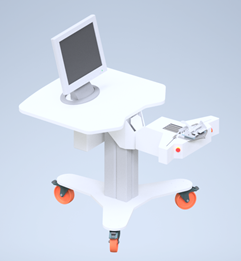
This device is an impressive robotic device specifically designed for hand therapy. The results obtained from its use in stroke patients indicate its effectiveness in reducing hand injuries. The embedded technology in terms of sensors and actuators is able to objectively determine the movement status of patients after brain damage as well as their movement recovery. In fact, this device is able to obtain kinematic and kinetic data that are processed to obtain quantitative indicators.
It is an end effector robot with 5 degrees of freedom. It allows movement of one or all five fingers thanks to a passive rotary joint between the tip of the finger and a laterally moving object (the thumb has two passive rotary joints). All five mechanisms are independent of each other and provide a wide coverage of the working space of the finger. This setup consisted of securing a small magnetic disc to each finger with adhesive tape to connect to the end of the effector, which moved back and forth inside rails aligned with the direction of the finger.
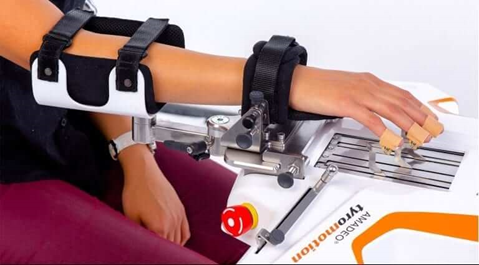
The wrist is immobilized using a strap to prevent the elbow and shoulder from moving. The robot can calibrate the full passive range of motion for each finger before starting the task and provide the assistive force to patients to complete the remaining range of motion during exercise. In addition, it provides maximum flexion and extension force for each finger and the exercise is recorded when power control is required. Three different assessments were performed by this device:
Strength assessment: measures the patient’s isometric strength for each individual finger and hand strength.
Muscle power assessment: measures passive base force of finger muscles.
This device simulates the natural movement of grasping and is imprinted on the patient’s hand. As simple as this step may seem, the body’s processing and healing process is very ingenious. The brain, stimulated by the movements of the hands and fingers, begins to reorganize or readjust the motor functions stimulated by the movements of the hands and fingers. In this process, intensive practice with high frequency of grasping movements especially promotes the learning process.
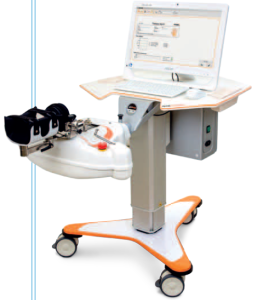
It improves motor skills as well as finger or hand strength and reduces spasms. In this way, it helps patients regain as much natural range of motion of their hands as possible.
Continuous and ergonomic simulation of grasping movements
ideal for all stages of neurorehabilitation in the form of active, auxiliary and passive treatments
CPM therapy Passive hand is stimulated
Assistive therapy Active training at the level of individual performance
Interactive therapy Active training in a virtual environment based on performance Goal oriented different tasks
